Showing posts with label Dive Flag. Show all posts

Thursday, 11 July 2013

Sharkskin

Introduction:


A dive mentor of mine once said: 


"...if you dive the same conditions over and over, 
then you are likely to have only re-occurring dive experiences."

That is, if you only dive in shallow, crystal-clear and warm tropical waters, then you are limiting yourself from diving with marine life that do not favor these conditions and you cut out a large percentage of possible dive locations. This is why I, as the owner of Dive Flag App and an adventure diver, make an effort to dive both day and night, travel the world and permanently seek new dive activities and experiences. This is also why I started planning my first cold-water dive trip to Melbourne, Australia.


Good diving practice is to speak with locally based divers to find out what the dive conditions are like. Melbourne based divers were quick to notify me that water temperatures can be expected to drop as low as 14 degrees Celsius. Furthermore, they recommended diving in a dry-suit. However, I found it difficult to justify the price of a dry-suit for the occasional cold-water dive. After speaking with more divers a friend introduced me to Sharkskin.


Sharkskin is an Australian based manufacturer of a technical water sports apparel that includes 100% Chillproof garments which provide warmth and wind protection. They also manufacture performance garments which include compression technology to aid in muscle recovery and rapid dry garments which are perfect for summer or layering on top of other Sharkskin garments for extra warmth and sun protection.

Sharkskin claim to be ideally suited to active water sports, such as; scuba diving, snorkeling, kayaking, stand up paddle boarding, yachting, surfing, jet skiing, water skiing and river rafting.

As most divers would be aware, being cold underwater is far from preferable and in some cases can be very dangerous. So, I put Sharkskin to the test and the results surprised me!

The Sharkskin Range:

The Sharkskin range is comprehensive and allows for cross matching garments depending on the activity you engage in. Their four product ranges include:


Sharkskin's product range claim the following key performance features:

SPLASHPROOF: Durable water repellent outer layer to provide a protective shell that ‘sheds’ water.
CHILLPROOF: High quality next-to-skin fleece to wick moisture and keep you warm and dry
SUNPROOF: Sharkskin garments range between SPF30+ / 50+ for protection from UV rays.
WINDPROOF: ‘Technical’ membrane layer which is 100% windproof to stop windchill.
PRO: Compression material for maximum maneuverability, endurance and recovery.

The above information got me excited to test their products. I decided to start by testing their cornerstone range, Chillproof, which includes a thermal insulation layer which can be used as a stinger-suit or an added layer of insulation under your existing wet-suit. This range has a purposeful 3-layer composite material designed to keep you warm during cold-water dives. I have outlined my first Sharkskin experience below.


My Sharkskin Experience:


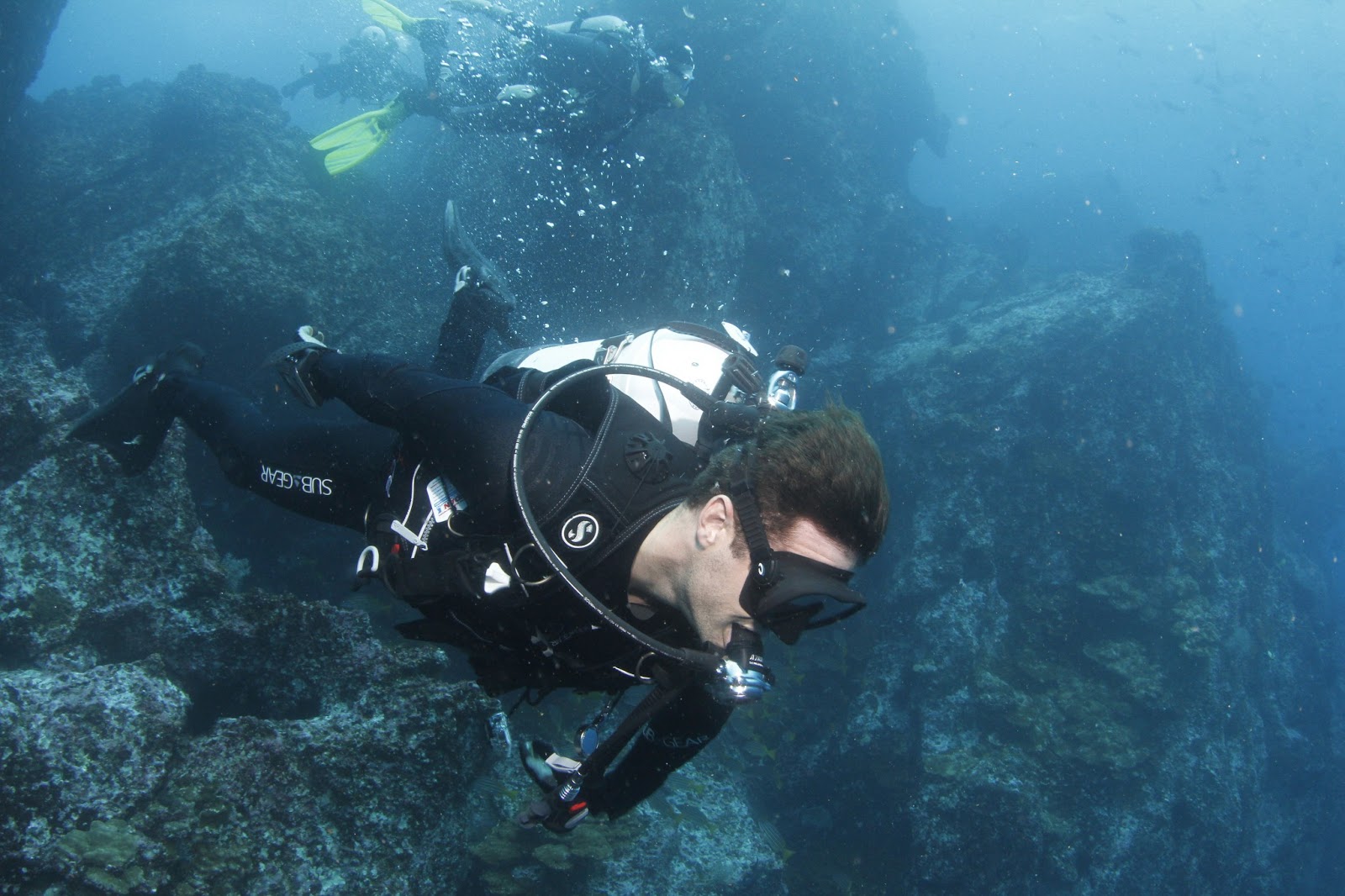
I had the opportunity to trial the product on one of my recent excursions. The water temperature was 21 degrees Celsius. Diving for 45 minutes at this temperature can feel quite cold because you lose your body heat up to 25 times faster underwater than you would above water. I did not wear any Sharkskin product on my first dive. This allowed me to confirm that my regular wet-suit was not enough to keep me warm under these conditions. After an uncomfortably cold dive, I put on the long sleeve Chillproof top (pictured below). I found the product very easy to slip on. The thumb loops allowed me to keep the Sharkskin product in place when sliding my wet-suit on over the top. Once on, I removed my thumbs from these loops. 


After re-entering the water it took about 5 minutes for the water to fully penetrate the Sharkskin layers - after which, my body heat had accumulated and increased once again to a comfortable level. This allowed me to be more comfortable and relaxed on the dive. Furthermore, as I was taking photographs on the dive, it allowed me to steady my hands and take photographs with greater accuracy. I also found myself concentrating on the fun aspects of diving rather than being reminded of how cold I am. 


Once we emerged from the water other divers were shivering and talking about how cold they were, rather than the typical topics of discussion, including; what we saw and how awesome the dive was. Once I removed my scuba equipment and placed it aside I could actually feel warm water trickle from around the ends of my sleeves and down my fingers. On the day this feeling was especially obvious. I couldn't help but chuckle to myself over the fact that I have suffered unnecessarily on cold dives so much in the past.

After I removed my wet-suit I was interested in testing the Sharkskin product as a wind breaker. On our return trip the vessel was travelling at 20 knots. With the rapid drying of Sharkskin products I was dry in no time. Furthermore, with its three layer system no winds penetrated the garment.


Dive Flag App's Overall Review:


Sharkskin is an absolute must for every diver. The flexibility of their garments (combinations in which they can be worn) and the activities for which they are suitable - make them fantastic value for money. 

Advantages I observed of Sharkskin from my trial: 

1) It allows you to convert your standard wet-suit into one more suitable for cold waters. 
2) The product appears to be made of high quality materials and long lasting stitching. 
3) The material is flexible and comfortable enough to be used as a 'stinger-suit'.
4) Sharkskin garments dry much faster than conventional wet-suits.
5) The product is light and flexible making it easy to travel with.
6) It provides a smooth layer, making it easier for slipping on your wet-suit.

I found all the following, before mentioned product performance features, accurate:

SPLASHPROOF: The product is quick drying and lets very little water in.
CHILLPROOF: The garment kept me warm and dry with only small amounts of water trickling out at the end of the dive.
SUNPROOF: The garment is suitable for wear above the water keeping me out of direct sunlight and the sometimes harsh Australian sun-rays.
WINDPROOF: The garment prevented the cool winds from penetrating to the skin.
PRO: The garment was very flexible and did not limit any movement.


This is no wonder why so many ambassadors have put their name forward in support of the product:


There are so many applications for Sharkskin apparel that the possibilities are endless. Whether you're male or female, after long or short wear garments, or just plain wanting to look good - then this is the product for you. I found it comfortable to wear and that it met its marketing promises.

Over score: 10/10


If you would like more information regarding this experience or the product, please feel free to contact me ( info@diveflagapp.com ). I would be more than happy to answer your questions. 

For more product and stockist information please visit the Sharkskin website. 

Frank Vorster
Dive Flag App
Owner
info@diveflagapp.com 

Wednesday, 5 June 2013

The DeepSee Submersible Experience - on the Argo

Note: 

The submersible mentioned in this review is on-board the Argo vessel, and so we recommend reading Dive Flag App's review on the Argo vessel, before reading this review.  

Briefing: 


The Argo vessel has a submarine on-board, which allows recreational divers for the first time to experience the deeper ocean crevasses surrounding Cocos Island. The Undersea Hunter Group gained inspiration to add this vessel after assisting in the production of the documentary 'Coral Reef Adventure' and after conducting many deep ocean explorations by scuba. 


Before the submersible operators take any firm bookings, they conducted a brief presentation regarding the on-board submarine. The presentation covers expected duration underwater, the type of experiences you can expect and the pricing. This presentation provides for a fantastic opportunity for passengers to ask any questions they want about the experience. After this presentation passengers can book either a 100 m or 350 m dive experience. Each experience is unique and so, should there be spots available and budget permitting it is highly recommended that you do both.

The submersible


The DeepSee is a custom-built one-atmosphere submarine, capable of carrying a pilot and two passengers to a depth of 1,500 feet (450 meters). It is a flexible, capable and masterfully designed vehicle that can agilely operate throughout its range in comfort and safety. 


The view from DeepSee’s acrylic sphere is unparalleled, with a 360-degree field of vision. The 4-inch thick acrylic sphere actually disappears when immersed, giving the astonishing sensation of total freedom.

You feel entirely comfortable and safe at the maximum speed of 1.7 knots.


Our experience:


The Undersea Hunter Group takes safety very seriously. Two members of the submersible crew sit down and run you through the experience by way of briefing and then caution you as to the safety procedures. Rest assured that the submarine is designed and built with safety in mind.


We are provided with safety gear: a blue jumpsuit and rubber shoes. After putting on the safety gear we walked outside to where they have already lowered the submersible into the ocean. You walk onto a standing platform and then lower yourself into the dome of the submarine.


Philippe was our pilot for the journey. Once in the dome the submarine pilot quickly makes you feel comfortable and relaxed about the experience you are about to undertake. Once in and sealed within the atmosphere the submersible is reversed out of the protective and sheltered area. A crew member then snorkels up to the front of the submersible and connects a towing line to a tow vessel. The vessel then tows the submersible to the island’s outer reef. After a quick and exciting final briefing the DeepSee vessel is lowered.

On the descent the submersible operator begins pointing out interesting fish and you get a complete run down on the behavior feeding and breeding cycles of each of them. 


After spending time at the Everest we man-oeuvred towards the Bajahara. It is on this short journey when you can expect to see the silhouettes of hundreds of hammerhead sharks swimming near the surface closely packed to one another.


During our submersible experience we sighted a Galapagos shark which quickly became over shadowed by a larger and closer Tiger shark. The surface tug boat and the submersible are in communication at all times. In fact the surface boat was able to advise us of a tuna feeding frenzy heading in our direction. By the time the submarine was able to orientate in the correct direction we were in prime position for the viewing of the feeding. We also sighted black coral, mobula rays, a lot of deep water fish and eels. We were submerged for over 1.5 hours.

Our pilot Philippe paused momentarily during the submersion to record ocean water values, like; salinity, temperature and current. These values are then provided to universities to assist in research projects - which for example measure physical changes in the Ocean. This is just one of the many examples of how the Undersea Hunter Group work with research authorities around the world.

Click here for pricing information.  

Dive Flag App's Over Review:


This is by far one of the most enjoyable complimentary scuba diving activities available. If you enjoy scuba diving you would enjoy this. You're in complete comfort and exploring parts of the world that even most scuba divers would never see. You're able to communicate with the operator and the other passenger about the animals and landscape. It's just as educational as it is enjoyable. 

The Undersea Hunter Group have done a great service in making this experience more accessible to a larger population. The safety procedures and briefing were impeccable and like all other experiences with the Undersea Hunter Group - as safe as it could get. 

We are grateful for the opportunity, experience and memories that will last a life time!


Best regards, 


Frank Vorster
Dive Flag App
Owner

Tuesday, 28 May 2013

Undersea Hunter Group - the Argo

Location: Isla del Coco (Cocos Island), Costa Rica. 


We boarded the Argo in Puntarenas, Costa Rica, and were welcomed by the crew with fresh fruit smoothies, firm handshakes and warm smiles. During lunch we disembarked and started our 36-hour boat ride to Isla del Coco (Cocos Island). It is at Cocos Island that we spent 7 days diving some of the most incredible dive spots the world has to offer. Cocos Island is known for its biodiversity of mega fauna, boasting significant schools of hammerhead sharks, whale sharks, yellow-fin tuna, Galapagos sharks, rays, tiger sharks and enormous schools of fish. 

Cocos Island was formed during a volcanic upheaval about two-and-a-half million years ago and is composed of basaltic rock, labradorite and andesite lava flows. It is located in the Eastern Tropical Pacific, 300 miles southwest of Costa Rica: ~ The Undersea Hunter Group.

The Vessel


The Argo vessel is equipped with everything you could imagine being required for the most luxurious of live-aboard trips. The cabins are comfortable and spacious; each with its own en-suite, two bunk beds & ample storage.

  • Level 1: 6 twin-share cabins.
  • Level 2: Cinema, dining area, kitchen, dive platform, camera storage, dive-gear storage & submersible.
  • Level 3: Lounge room, bridge, bow section, sun deck & 4 twin-share cabins.
  • Level 4: Sun deck complete with a 360 degree view.


For a detailed and interactive deck plan of the Argo click here.

Meals


Meal times are structured, with breakfast at 8 am, lunch at 1 pm & dinner at 7 pm. Snacks, including sandwiches/wraps/pastries, are served after every dive. The kitchen is permanently stocked with free beer and other non-alcoholic beverages, such as tea, coffee, juice, iced tea and sodas. The boat has a wine cellar on-board, where you can purchase from a wide selection. You are free to bring snacks and drinks on-board too.

The chef is able to cater for all dietary in-tolerances including gluten. The kitchen goes as far as to provide gluten free: beer, cereals, snacks and desserts.

Typical meals include:

  • Breakfast: omelettes, fresh toast and fresh fruit
  • Lunch: rice, beans, chicken legs/fresh fish and salad.
  • Dinner: burgers/steaks, salad, vegetables, tiramisu  


In the late evening, after dinner, the dive schedule for the next day is provided.

On-Board Extras and Activities 


When aboard the Argo you can expect to complete between 21 & 25 dives over 7 days. You are able to sit any dive out, should you become exhausted. If you do, there are many free on-board activities you can enjoying, including:
  • A surround-sound cinema with a comprehensive movie library
  • Board games
  • Book library 
  • Sun deck for sun-baking
  • Taking photos of Cocos, the horizon or sunrises/sunsets from the Argo
  • Engage freely with the staff, asking as many questions about the island and the ecosystem as you would like, as they are all competent team members with plenty of experience

These activities help to create and strengthen new friendships between passengers, staff and Cocos Island rangers when they are on-board.


A free laundry service is provided on the boat. This means you can travel light and not worry about running out of clothes.

On-board satellite internet is available for $20 per megabyte.

Dive Breakdowns 


It is expected that you bring your dive certification card & dive insurance details with you. All tanks are filled with Nitrox so it is paramount that you are suitably certified. Two tender boats shuttle you from the Argo to each dive site. Most dives begin with negative descents and require a roll back entry. During the dive briefing you will be instructed to meet at 10, 15 or 20 m depth at a particular underwater location. A dive is never cancelled due to weather because the island always has at least one sheltered side. Below is a summary of the dive experiences at each dive sight.


The above is a dive map illustrating the below outlined dive sights and what megafauna was spotted where. 

Dive #1 - Chatam Bay


The Undersea Hunter Group take safety seriously. We performed our first dive in Chatam bay at a max depth of 15 meters, to test our equipment and buoyancy and to become accustomed to the water temperature. Two Cocos Island rangers followed us to ensure that we were not touching any marine life and that we were only settling on exposed rocks and / or sand.

Dive Details:


Maximum Depth: 15.2 (m) / 50 (ft)
Nitrox Enriched Air @ 32%
Water Temperature: 29 degrees Celsius
Downtime: 57 minutes


Upon our return to the Argo we were provided with a dive briefing for the next two dives. This was followed by a presentation prepared by the Cocos Island park rangers. The presentation included ranger duties and goals, helpful diving tips, an outline of what to expect when diving at Cocos Island and information regarding on-land tours.

Dive #2 - Manuelita Out


At Manuelita we saw a whale shark, oceanic manta ray, Galapagos shark, yellow-fin tuna, mobula rays and a school of hammerhead sharks. The Undersea Hunter Group compiled the official dive map / sites for the island. This is a testament to the experience and knowledge the crew have about the island and what lives there. Their understanding of currents, times and seasonal variances make them dive-planning experts.

Dive Details:


Maximum Depth: 31.9 (m) / 104 (ft)
Nitrox Enriched Air @ 32%
Water Temperature: 28 degrees Celsius
Downtime: 40 minutes


Dive #3 - Manuelita Channel


This was a nice and relaxing dive. We had ample opportunity to practice our photography skills as the current drifted us along.

Dive Details:


Maximum Depth: 22.5 (m) / 73 (ft)
Nitrox Enriched Air @ 32%
Water Temperature: 27 degrees Celsius
Downtime: 44 minutes


Dive #4, 11, 16 - Dirty Rock


Dirty rock has a high number of cleaning stations where heaps of marine animals come to get cleaned. This includes the white tips, Galapagos sharks and whale sharks. Immediately below the anchor point/boat at 30 meters is the first of many cleaning stations. Without fail many white tips settled less than a meter away from our group at this station.

Dive Details:


Maximum Depth: 35.0 - 35.6 m / 
Nitrox Enriched Air @ 32%
Water Temperature: 27 - 28 degrees Celsius
Downtime: 47 - 49 minutes

On dive #4, within the first 20 minutes of settling at this cleaning station, we saw over 50 hammerhead sharks come in slow and close. Over the rest of the dive, from Dirty Rock out to the Pinnacle, we saw at least another 50.


On dive #11, immediately after entry we saw a whale shark at about 20 m in depth and it circled back at about 10 m in depth and moved slowly above us. We continued to the west side and spotted a significant number of hammerhead sharks. At the end of the south side we encountered two large eagle rays dancing  for all of us. We continued to sight large yellow-fin tuna, hammerheads and a second whale shark. The second whale shark swam along the whole face of the north wall, providing for fantastic photo opportunities.


Dive #5 - Maria’s Punta 


This dive site is one of the furthest from the Argo anchor point. Travel by tender takes approximately 15 minutes. This was a very relaxing dive which wasn't challenging (demanding).

Dive Details:


Maximum Depth: 33.5 (m) / 109 (ft)
Nitrox Enriched Air @ 32%
Water Temperature: 26 degrees Celsius
Downtime: 46 minutes


Dive #6 - Coral Gardens


This is a relaxing open dive with schools of up to 40 white tips, frog fish, marble rays, flounder, moray eels, damsel fish, lobsters and yellow-fin tuna. This dive site is 3 minutes further away than Maria’s Punta. As we transferred out to the dive site we stopped a few times to view numerous waterfalls.

Dive Details:


Maximum Depth: 25.9 (m) / 84 (ft)
Nitrox Enriched Air @ 32%
Water Temperature: 27 degrees Celsius
Downtime: 48 minutes


Dive #7, 13, 14, 17 - Bajo Alcyone 


Discovered and named by Jacques Cousteau, this is a fantastic dive site. During periods when there is no current, you can expect to find schools of fish in 10s of thousands. During periods of increased current you can expect to find schools of hammerheads.

As we started dive #7 we observed dolphins playing at the surface. From the moment we entered we could hear the dolphins singing. We descended to the cleaning station at the end of the anchor line and observed huge schools of fish, hammerheads and moray eels making use of the cleaning stations. As we were drifting back to the anchor line a pod of 5 dolphins swam less than 5 m behind us. At the end of the dive, during our deep safety stop, a whale shark swam by the group about 7 m above us,

During dive #13 the swell and current were calm. We observed a green sea turtle being cleaned in the cleaning station near the anchor line. Schools of hammerheads were nearby and circling in and out of the cleaning station. Approximately half way through the dive we looked up and saw two the silhouettes of two manta rays. 

Dive #14 and #17 were particularly awesome as we saw massive schools of hammerheads swimming above us. This was particularly amazing to see because it is for this that Cocos Island is known: this is represented in the logo, its theme and encourages world of mouth.

Dive Details:


Maximum Depth: 30.6 - 36.7 (m) / 100 - 120 (ft)
Nitrox Enriched Air @ 32%
Water Temperature: 26 - 28 degrees Celsius
Downtime: 42 - 52 minutes


Dive #8 - Submerged rock


On this dive it is particularly important to do a roll back entry and sink quickly to the bottom. This is because the tender drops you as close to the swim through as possible. Once you reach the bottom a dive guide motions for each diver to take a turn swimming through the submerged rock. This allows for each diver to have a similar experience. Once each diver has swum through, the group spiral around the dive site, gradually getting shallower. On this dive we saw many large schools of fish, moray eels and spider crabs.

Dive Details:


Maximum Depth: 31.2 (m) / 100 (ft)
Nitrox Enriched Air @ 32%
Water Temperature: 28 degrees Celsius
Downtime: 50 minutes


Dive #9 - Manuelita


This was a very quite dive relative to all the others. Here we saw white tips, eagle rays, sea urchins and plenty of moral eels. The variety that the island has to offer is continually surprising.

Dive Details:


Maximum Depth: 30.2 (m) / 100 (ft)
Nitrox Enriched Air @ 32%
Water Temperature: 29 degrees Celsius
Downtime: 55 minutes


Dive #10 - Manuelita (Night Dive)


The tender boat took us 250 m from the Argo, to the north side of Manuelita. We descended to the ocean floor at about 18 m deep and gathered in closely. At night, schools of white tips and jacks hunt. The white tips feel the vibrations of small fish in and among the coral and attack in a clumsy fashion. The jacks are more precise and efficient in hunting. 

On the safety stop the dive guide motioned for us to turn off our torches so that we might enjoy playing with the phosphorescence. This was exciting and even without the torches you could make out a surprising amount of detail in the ocean floor, and the actions of the divers surrounding you.

Dive Details:


Maximum Depth: 18.1 (m) / 60 (ft)
Nitrox Enriched Air @ 32%
Water Temperature: 28 degrees Celsius
Downtime: 48 minutes


Dive #12 - Chatam Bay @ Night


Chatam Bay was more active than Manuelita during the night, probably because there are more, smaller fish for the white tips and jacks to feed on. There were approximately twice as many white tip sharks present, with an estimated 150+. On this dive we also observed large moray eels scampering along the ocean floor.

Dive Details:


Maximum Depth: 11.8 (m) / 38 (ft)
Nitrox Enriched Air @ 32%
Water Temperature: 27 degrees Celsius
Downtime: 33 minutes


Dive #15 - Manuelita Out


Numerous hammerheads came in very close to us as they were getting cleaned. The owner of the Undersea Hunter Group and inspirational player in the ocean conservation movement, Avi Klapfer, joined us on the dive. It was really an honor to dive along side him. We started on the south-east end of the island and traveled west against the current. We did this because marine life often travels against the current too. We saw many Galapagos sharks – in fact one extremely large male approached a mobula ray from behind rather inquisitively. The mobula ray darted off just in time. During our safety stop we saw a very large school of hammerheads travelling approximately 20 m below us.

Dive Details:


Maximum Depth: 31.7 (m) / 104 (ft)
Nitrox Enriched Air @ 32%
Water Temperature: 28 degrees Celsius
Downtime: 61 minutes


Dive #18 - Manuelita


This was a nice and casual way for us to end the dive trip. Max depth was less than all the others. The visibility was very average on this dive. At around 3:45 pm the lobsters were emerging and the jacks were starting to feed.

Dive Details:


Maximum Depth: 30.8 (m) / (ft)
Nitrox Enriched Air @ 32%
Water Temperature: 28 degrees Celsius
Downtime: 49 minutes


Overall Rating:


The Undersea Hunter Group is one of the most professional dive companies we have dealt with. Their attention to detail and diver safety are unrivaled. The crew are eager to please and are passionate about the location and company for which they work. This makes it one of the most pleasurable, informative and overall exciting live-aboard experience we have encountered yet.

The vessel is the most luxurious and spacious vessel that dives at Cocos Island. Furthermore, it has an on-board submersible that enables you to further your already intimate experience of Cocos Island by viewing it from a few hundred meters below sea level. This is both exciting and memorable. The review for this experience will be published soon.

The knowledge possessed by those on board enabled us to see and experience what we did. It is not without the decades of experience accumulated by members on board that we could have see everything we set out to seen. The crew are so passionate about the Cocos Island experience that they naturally tell you the history of the island and biology of the life you see.

We asked the passengers on board what characteristic they appreciated the most about the vessel in particular and these were the top three:
  • Space
  • High quality of food
  • Impeccable finish and cleanliness to the vessel
If you are going to take the time to visit Cocos Island and to experience what has been outlined above, you are going to want to do so with the Undersea Hunter Group. They have two vessels available and we strongly suggest that you view their website for more information: http://www.underseahunter.com/

Dive Flag App proudly support them and look forward to diving with them again some time soon. 

Dive Flag App Rating 10 / 10


Thanks guys!

Best regards,


Frank Vorster
Dive Flag App
Owner
info@diveflagapp.com